26 March 2014

Sofonisba Anguissola

One of the women artists in focus this week is Sofonisba Anguissola, who was an Italian painter during the Renaissance. Uniquely, she was both placed in an artist apprenticeship and educated in the humanist tradition from a young age. She became a famous artist, notably acting as Court Painter in Spain and as Lady-In-Waiting to the Queen of Spain. She also employed new techniques in painting, as well as lived in various places throughout Europe. As a woman, her creativity provided her with prestige and money, which enabled her to travel and live a life of her own choosing in many ways. However, her status did not, until more recently, secure her fame after death. For example, the National Museum of Women in the Arts explains that “Anguissola’s fame slowly disappeared towards the eighteenth century with many of her works being ascribed to male artists.” One has to wonder how it is possible that a woman in such a public light, having such a documented presence was not given due credit only a century after her death in 1625? Perhaps, patriarchy had changed its shape by the eighteenth century, strengthening its hold on culture and thus, artwork as a means of expression, revising women’s roles in the art world during the Renaissance and ignoring the tradition of women’s public participation in art even dating to the Ancient world. In addition, Anguissola more than likely does not represent the average woman during the Italian Renaissance, yet her story can demonstrate that women used their means or talents to further their own agency and were not only accepted in, but were inherently a part of the public and cultural sphere.

Source: http://clara.nmwa.org/index.php?g=entity_detail&entity_id=116


The Chess Game -1555
Her most famous painting, showing her three sisters and a servant.
http://favourite-paintings.blogspot.com/2011/03/sofonisba-anguissola-chess-game.html


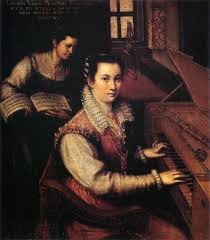
Self-Portrait, 1554
http://www.csupomona.edu/~plin/women/anguissola.html

Anguissola, Elizabeth of Valois

Elizabeth of Valois (Spanish Queen)
Sofonisba Anguissola 
1565

http://www.mystudios.com/women/abcde/sofonisba_valois.html

25 March 2014

Lavinia Fontana

I looked at several paintings by Lavinia Fontana. Based on some of the paintings she seems to be a very religious person. And this painting could be a declaration to that. As what seems common among religious women in these days the virgin Mary is very highly regarded. This painting is in praise to Mary and it even seems to place her higher than other men; even men such as Saint Peter. Mary is the focal point of the picture and all surround her. I feel like in several other of her paintings that she had painted infants; and it looks like all the faces that surround her could be infants too. Is this a representation of Baby Jesus or is there some other kind of significance to that?


Assumption of the Virgin with Saints Peter Chrysologus, and Cassian - Lavinia Fontana

Lavinia Fontana

   Lavinia Fontana was from Bologna, Italy and acquired her artist techniques from her father. According to the Coursepacket, Lavinia's father needed his only child to support the family, so he trained her to be a painter (CP 150). Although she may have been taught the basic technique from her father, Lavinia became a master and her work spoke for itself.
  Lavinia had many patrons who requested various works of art from her, many were portraits but one of her largest and most well-known pieces is the "Assumption of the Virgin" that was in Cardinal Gabriele Paleotti's chapel in Bologna cathedral of San Pietro (CP 151).    Lavinia supported her large immediate family, 11 children total, and made such a name for herself that she and her family moved to Rome in 1604 where she became a portraitist for Pope Paul V (National Museum of Women in the Arts 1).
   The year 1604 also marked another milestone in Lavinia's career. According to Encyclopedia Brittanica, "this was the year that she painted her largest work, the "Martyrdom of St. Stephen, an altarpiece for San Paolo Fuori le Mura in Rome, a basilica that was destroyed in the fire of 1823 (1). According to various documents that contained records of the money that Lavinia received from her art work, scholars have found that upon her death, she had acquired a total sum of several thousand scudi (CP 152).
  Lavinia is proof of the fact that women could and can "easily" stand alongside male artists and be successful.

This is a self-portrait of Lavinia:
This is the "Assumption of the Virgin" piece:
 These are various pieces:


Works Cited
"Lavina Fontana." National Museum of Women In The Arts. Accessed March 25, 2014. http://www.nmwa.org/explore/artist-profiles/lavinia-fontana.
"Lavina Fontana." Encyclopedia Brittanica. Accessed March 25, 2014.http://www.britannica.com/EBchecked/topic/212506/Lavinia-Fontana. 
All visuals are from Google Images 

Artemesia Gentileschi

Born in 1593 to famous painter Orazio Gentileschi, Artemesia would grow up to be one of the most famous baroque artists from the 17th century. Trained mainly under her father, she drew influence from Caravaggio, using dark colors and shadows and contrasting light and dark for emphasis in paintings. As well as the play on shadows, many of Gentileschi's paintings often depict violence, which relates back to the incidence that happened while she apprenticed with Agostino Tassi. Raped by her father's colleague at the age of 18, she took Tassi to trial. And though she was able to confirm the rape testimony (gathered under torture) and was able to get Tassi convicted, he never served time. Her angst over this can be seen in some of her more brutal paintings, particularly the Judith portrait in which she uses a biblical scene to convey the message that women will achieve justice by whatever means necessary:
 
Gentileschi, in most of her paintings, portrayed women her were both strong and vulnerable, much like herself.
Other paintings:


Source used: http://www.artic.edu/exhibition/violence-and-virtue-artemisia-gentileschi-s-judith-slaying-holofernes

Plautilla Nelli


The work of Plautilla Nelli (1523-1588) consists of a variety of biblical classicism.  According to the source, Nelli is the first documented female artist from Florence, Italy.  She had originated as a nun, serving the church in Piazza San Marco.  The source explains that Nelli discovered the works of Savonarola studied this particular style.  Nelli's work paved the way for other women artists, and brought an original style to the art in which she had created. 


In Nelli's portrayal of The Last Supper, now located in a private viewing collection,  represents the experience of Christ and his disciples.  According to the source, this painting follows the representation of classic still-life paintings, and the smooth transitions in the clothing compliment the overall style of the painting. 


The Pentecost, pictured above, is another celebrated work of Nelli. Like the depiction in The Last Supper,  This image provides smooth, classic transitions and a contrast of light and dark colors.  Nelli's influence from the works of Savonarola and Bartolomeo can  be witnessed in this painting along with many others in Nelli's collection. 


Sources:

http://www.theflorentine.net/articles/article-view.asp?issuetocId=1475

http://en.wikipedia.org/wiki/Plautilla_Nelli

http://www.advancingwomenartists.org/suor-plautilla-nelli-restoration.php

17 March 2014

A Review of the Movie Gravity Using the Bechdel Test


       The Bechdel Test is fun and interesting because it allows historians to combine their own historical analysis with the film industry and popular culture. The test reflects how women are represented in our society in movies based upon a set of questions. In the future, historians may use current films to gauge women's roles and progress in the same way we analyze primary sources such as the letters between Magdalena and Balthasar or the Life of Christina of Markyate. This is one reason we should be concerned with the messages our movies send. What do they say about us?
     Today I watched the movie Gravity starring Sandra Bullock. I have used the Bechdel test to my best ability to judge whether the movie is positive for women or not. I will also include themes we have discussed in class regarding the history of women and the first feminists. Below is how Gravity fared with the Bechdel test.
1. The film must have two or more women- Yes, there are two women other than Sandra Bullock, one is a dead astronaut, and the other is corresponding with her at NASA headquarters while she is in space, however this woman is never shown.
2. These women must talk to each other- Yes, Sandra's character (Ryan) talks to the female controller shortly over her speaker.
3. About anything other than a man- Yes, the two women discuss what Ryan needs to do for her job.
     Although Gravity seems to have (barely) passed the Bechdel test, I will give my feedback which is a bit more thorough as well as critical of the movie. I first must point out the big picture, and that is that the plot of the story includes a sole female character who is intelligent, educated, and dedicated to her career. Besides a short dialogue of humorous relief between Ryan and her fellow astronaut, played by George Clooney, about whether she finds him attractive, little is mentioned about Ryan's sexuality as a woman. For the majority of the movie, her body is completely covered in the space suit with only her face visible. These are the good points I found, of which there are an equal amount of negative points.
     In my opinion, the movie is not only about a female astronaut who is lost in space and (spoiler alert) who finds a way to survive, it is also about the main character's journey from being weak in the beginning to strong in the end after being tested to ultimate extremes, both physically and mentally. In the beginning she is extremely emotional after her space station is hit by debris, destroying it and making her and one other astronaut alone in space. George Clooney's demeanor is on the opposite side calm, almost to the point of annoyance. During their scenes together the classic male hero theme arose when Clooney talked a hysterical Bullock through getting to a nearby space station before their oxygen ran out. Only after he saves her and sacrifices himself does Bullock begin to make choices for herself and towards her own survival.
      An apparent theme in the movie which relates to class is Ryan's role as a mother, the core purpose viewed for women throughout the Middle Ages and Early Modern Period. Even though Ryan does not talk about romantic relationships, she does reveal that she had a daughter who had died when she was four years old. This aspect of the movie is not negative when it relates to feminism, however it reveals that the "Ages of Woman" and motherhood are still important to what it means to be a woman in the eyes of modern audiences. It seems that the message being conveyed is that professional women can have both a career and a family, or  the fact that Ryan was a mother made her more "womanly." In the end, Ryan turned out to be a strong female character who uses her intelligence and training to direct and land an empty spacecraft back to earth. The movie passed the Bechdel test, however it includes interesting themes about women and their relationship with men and motherhood.

16 March 2014

Margaret of Anjou


Women frequently did exert and hold power in some type of fashion during the early modern period, even if not always occupying high positions of authority, because the public and private sphere, in reality, have never been and still are not distinctly separate from one another. However, it is, in some ways, easier to access narratives of power and gender through the few women who served as rulers simply because they lived majorly within the public eye. One such woman was Margaret of Anjou, the Queen Consort of England during the mid-fifteenth century. After her marriage to King Henry VI of England in 1445, she started to use her position for her own aims, acting as patron to Queen’s College in 1448 and actively participating in governmental matters, even monitoring and soliciting taxes, possibly in favor of her allies at court. Her agency was bolstered coincidentally by an illness (or the insanity) of her husband and the birth of her son. Her son, as an heir to throne, enabled her to have a stronger stake in it, while her husband’s absence gave her a freedom to pursue political objectives on his behalf but of her own choosing, including a strong support of the Lancaster side in the Wars of Roses. She was a strategist and played a leadership role in the conflict, executing policies that disfavored the Yorkists, garnering Scottish friendship, and attempting to bring French forces into the mix on the side of the Lancaster.

Thus, she was a strong female figure, one who acted as a diplomat and a political leader even within foreign courts, playing a large governance role during a time of war in order to protect her own political allegiances and impetuses connected to the Lancastrian party. However, women, in such a role, often received critiques of their power through connections of sexuality and their gender. For instance, Margaret of Anjou, in regards to her only son and heir to the throne, was accused of birthing an illegitimate child. Although obviously connected to a means through which her rivals could denounce her child’s claim and thus, in some ways, her own claim to rule, the suggestion of an affair on her part relates to an overall trend that women in power were often criticized through sexuality and due to a sense of gender transgression. In turn, the accusations align with the instability of England at the time. However, Margaret of Anjou appeared to promote a confident image of herself during the instability, and some of her letters survive, of which seem to be mostly to men in positions of authority, that attest to her agency as a woman.


Sources: